
Performance Marketing
How to Choose a D2C Marketing Agency in India: 12 Questions
Twelve practical questions to ask before you hire a D2C marketing agency in India, from margins and tracking to creatives, account ownership, reporting and pricing.
· 7 min read

Picking a D2C marketing agency in India is one of the most expensive decisions a young brand makes, and most founders make it on the strength of a good pitch deck. The deck shows logos, a few screenshots of high ROAS, and a promise of scale. Three months later the brand has spent ₹6 lakh on ads and retainers and still cannot say what worked.
This guide gives you 12 questions to ask before you sign. They are the questions we would want a founder to ask us, and they will help you separate agencies that run a system from agencies that run ads and hope.
Before you start: know what you are hiring for
An agency cannot fix a problem you have not named. Before you take a single call, write down which of these you actually need:
- Demand creation: Meta ads, Google ads, creators and content that bring new buyers.
- Conversion: a store that turns visitors into orders, with clear pricing, offers, trust and checkout.
- Brand: positioning, identity and communication that make people remember and choose you.
- Retention: WhatsApp, email and post-purchase flows that bring buyers back.
Most D2C brands need some of all four, but in a clear order. If your product page converts badly, a better media buyer will only help you lose money faster. If you have no brand, cheap creatives will hit a ceiling quickly. Knowing your bottleneck lets you judge whether an agency is pitching what you need or what it happens to sell.
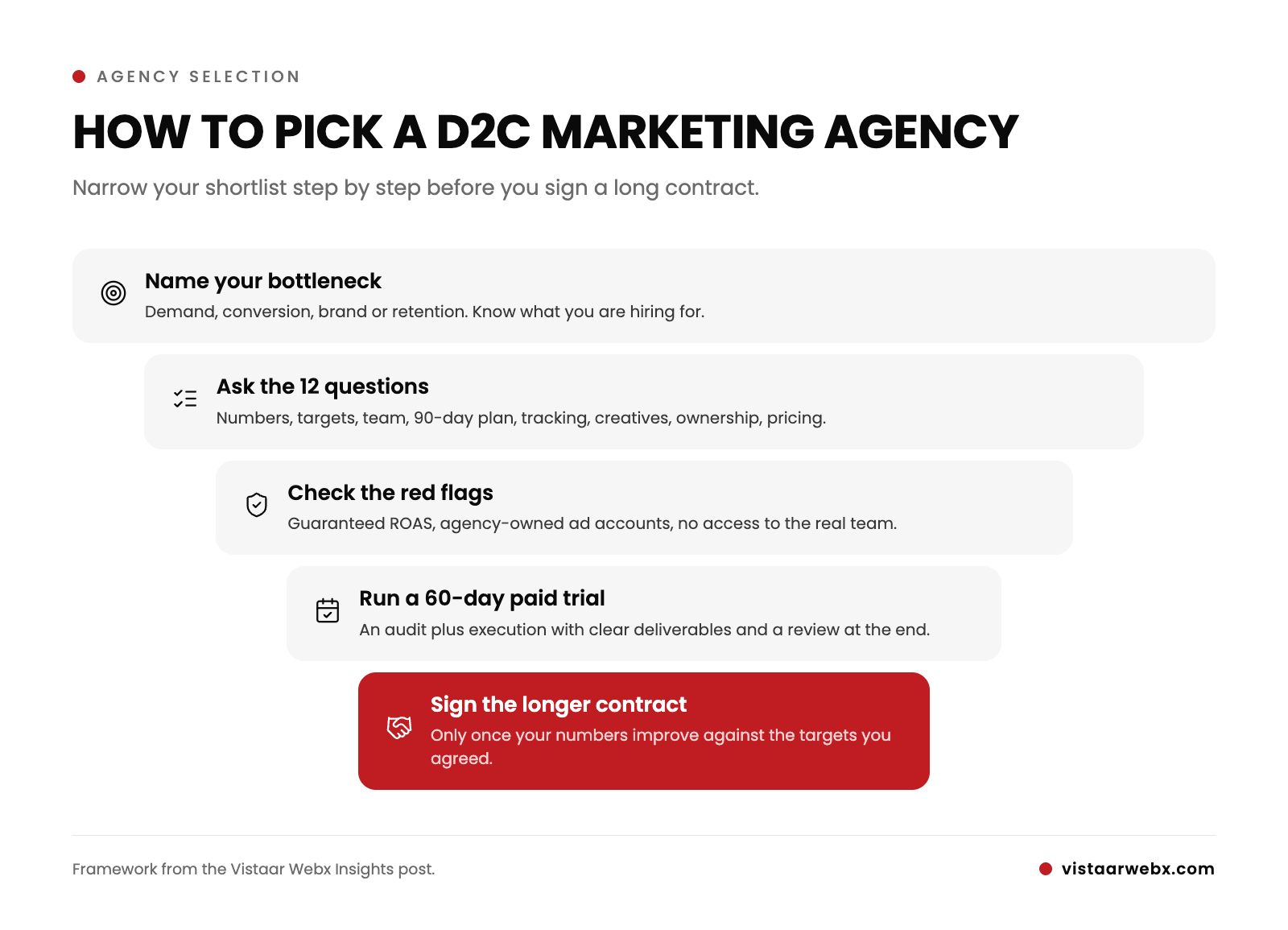
12 questions to ask a D2C marketing agency in India
1. What numbers will you ask me for in the first week?
A good agency asks for your contribution margin, average order value, RTO rate, repeat purchase rate and current CAC before it talks about campaigns. If the first conversation is about creatives and budgets without any mention of margins, the agency will optimise for ROAS on a screen rather than profit in your bank account.
2. How do you define success, and who decides the target?
Ask whether they report Meta-reported ROAS, blended ROAS (total revenue divided by total ad spend), or contribution after ad spend. The best answer is a target tied to your break-even CPA. For example, if your contribution margin per order is ₹700, any CPA above ₹700 loses money on the first order, whatever the dashboard says.
3. Who will actually work on my account?
The founder or senior strategist who pitches is often not the person who runs your campaigns. Ask for the names and roles of the people on your account, how many other brands each of them handles, and who you can call when something breaks on a Saturday during a sale.
4. What happens in the first 30, 60 and 90 days?
You want a plan, not a promise. A reasonable structure:
| Phase | Typical focus |
|---|---|
| Days 1 to 30 | Audit, tracking fixes, offer and landing page review, first creative tests |
| Days 31 to 60 | Double down on winning angles, cut losers, fix conversion leaks |
| Days 61 to 90 | Scale budget in steps, build retention flows, plan the next quarter |
If an agency promises scale in month one without fixing tracking, be careful.
5. How do you check tracking before spending?
Meta and Google learn from the conversion events your store sends them. Ask how the agency verifies the pixel, Conversions API, event deduplication and purchase values. On Shopify, the official sales channel handles most of this, but someone still has to test it with a real order. An agency that skips this step is buying traffic blind.
6. Where will creatives come from, and how often?
Creative is the main lever for D2C growth on Meta. Ask:
- How many new ads per week or month are included?
- Who shoots them: in-house team, freelancers, creators, or the brand?
- Do they write angles and hooks, or just edit what you send?
- How do they decide which ads to kill?
An agency with its own content and studio setup can usually test faster than one that waits for you to send product photos.
7. Can I see work that matches my category and stage?
A skincare brand at ₹2 crore a year has different problems from a handloom label at ₹30 lakh. Ask for case studies close to your stage. Read them for what was actually done, not just the headline. For example, our Atulya Karigari case study describes the UX spec, storefront redesign and gifting flows we built, because those were the real work.
8. Will I own my ad accounts, pages and data?
This is non-negotiable. Your Meta Business Manager, ad account, pixel, Google Ads account, Shopify store, domain and analytics should be in your name, with the agency added as a partner. If an agency wants to run ads from its own account, walk away. When you part ways, you should keep every learning and every audience.
9. How will you report, and how often?
Ask to see a sample weekly report. Useful reports are short: spend, orders, CPA, blended ROAS, new versus returning customers, top ads, what was tested, and one decision for next week. Long decks full of impressions and reach are a warning sign.
10. What do you need from me?
Good agencies are clear about the brand's homework: product samples for shoots, fast approvals, stock updates, offer decisions, customer service handling. Ask who approves creatives and how quickly. Slow approvals are one of the most common reasons agency relationships fail, and it is rarely the agency's fault alone.
11. How is pricing structured?
Indian agencies usually charge in one of three ways:
| Model | How it works | Watch out for |
|---|---|---|
| Fixed retainer | Monthly fee for a defined scope | Scope creep, unclear deliverables |
| Percentage of ad spend | Fee rises with your budget | Incentive to push spend over profit |
| Retainer plus performance bonus | Base fee plus a bonus on agreed targets | Targets defined on vanity metrics |
There is no single right model. What matters is that the scope is written down: number of creatives, platforms covered, landing page work, reporting cadence, and what costs extra. Ask whether GST is included in the quoted fee.
12. What happens if it does not work?
Ask about notice periods, minimum terms, handover of creatives and files, and how the agency will tell you if they think the problem is the product, price or website rather than the ads. An agency willing to say "your offer is the problem" is worth more than one that keeps asking for a higher budget.
Red flags to watch for
- Guaranteed ROAS numbers before they have seen your margins or tracking
- Running ads from the agency's own ad account
- No access to the people who will actually manage your account
- Case studies with big percentages and no explanation of what was done
- Reports that never mention blended numbers or your Shopify revenue
- Pressure to sign a long lock-in before any audit
Full-service or specialist?
A specialist media buyer can be a good fit if you already have a strong brand, a converting store and a steady creative supply. A full-service team makes more sense when your problems sit across brand, content, website and ads at once, because the handoffs between separate vendors are where most D2C growth gets lost. At Vistaar Webx we work across brand, content, digital, creative and growth for this reason, but the right choice depends on where your bottleneck is.
Run a paid trial before a long contract
If you are unsure, propose a defined first engagement: an audit plus 60 days of execution with clear deliverables and a review at the end. You will learn more about an agency from how it handles the first two months than from any pitch. Judge them on clarity of thinking, speed, honesty about what is not working, and whether your numbers improved against the targets you agreed on together.
Frequently asked questions
How much does a D2C marketing agency in India cost? It varies widely with scope, city and seniority. A focused performance marketing retainer costs less than a full-service engagement covering content shoots, website work and ads. Compare scopes line by line rather than comparing headline fees.
Should I pay a percentage of ad spend? It can work at higher budgets, but it rewards spending more rather than spending better. A fixed retainer with a clear scope, or a retainer plus a bonus tied to contribution margin, usually aligns incentives better for smaller brands.
How long before I should judge an agency? Give it around 60 to 90 days, provided tracking was fixed early and creatives were tested every week. If after 30 days you cannot see a plan, a test log and clean reporting, raise it then.
Do I need an agency based in my city? Not necessarily. Most D2C marketing runs remotely. What matters more is whether the team understands Indian buyers, COD and RTO, festive demand and regional nuance, and whether they can produce content for your category.
Talk to us before you sign anyone
If you are shortlisting agencies, use these 12 questions on us too. You can see the kind of work we do in our portfolio, read about our services, or tell us about your brand and we will start with your numbers, not a pitch deck.
- D2C marketing agency
- agency selection
- performance marketing
- Meta ads
- D2C India