
Performance Marketing
Meta Ads for D2C Brands in India: A Scaling Playbook
A practical system for scaling Meta ads in India: the numbers to know first, a simple account structure, a weekly creative pipeline and safe budget rules.
· 6 min read

Most Indian D2C brands do not have a Meta ads problem. They have a scaling problem. The first ₹30,000 a month usually works: a few good creatives, a warm audience, a product people already like. Then the founder doubles the budget, the cost per purchase jumps, and the account starts to feel like a slot machine.
This playbook is how we think about scaling Meta ads for D2C brands in India. It is written for founders and marketing leads who run their own accounts or manage an agency, and who want a system rather than a list of hacks.
Start with the numbers, not the ads
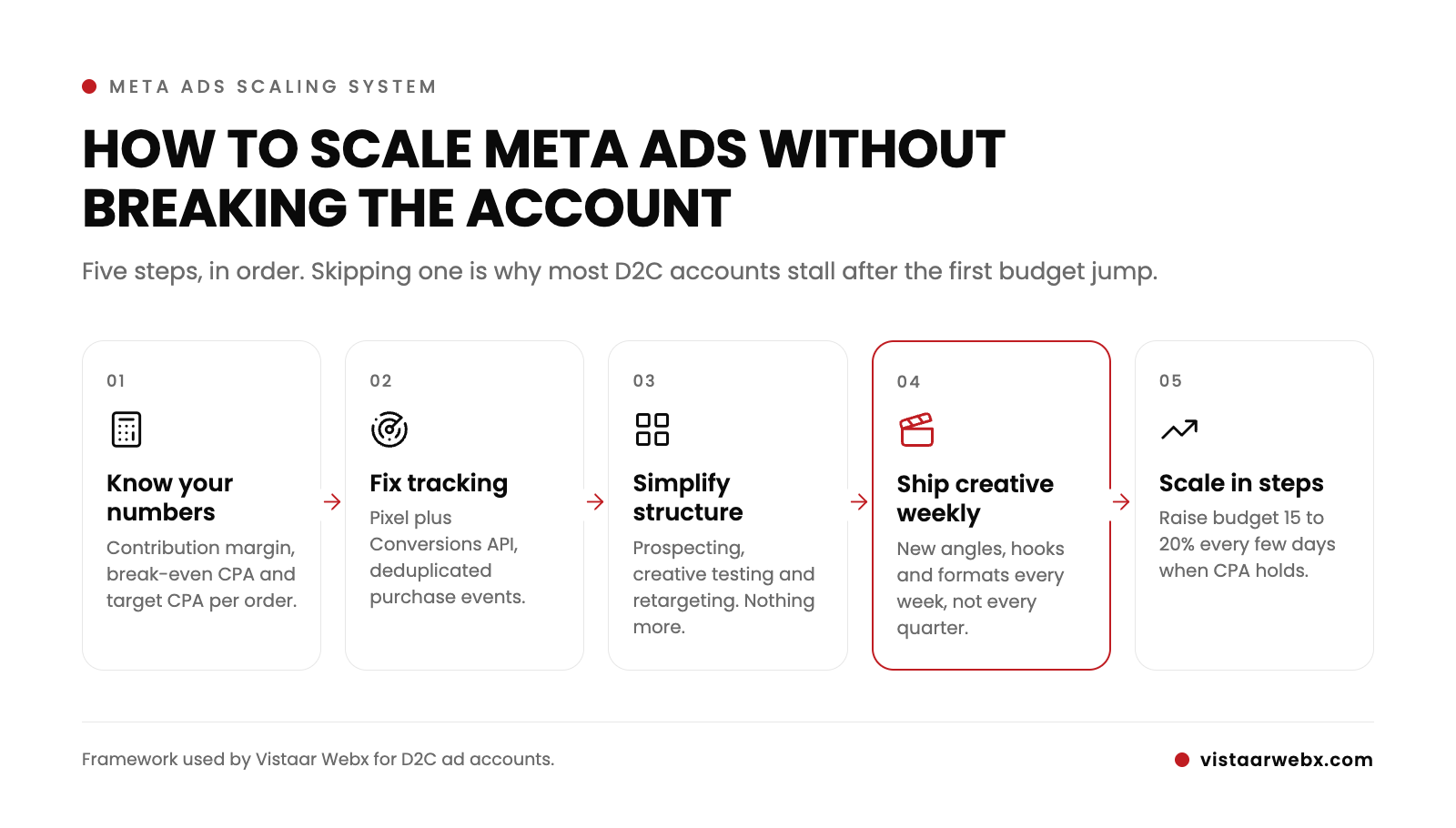
Before touching a campaign, work out three numbers.
- Contribution margin per order. Selling price minus product cost, packaging, shipping, payment gateway fees, and the cost of returns and RTO. For many Indian D2C categories, RTO alone can eat a meaningful share of margin on COD orders.
- Break-even CPA. The most you can pay Meta for one order without losing money on that order. If your contribution margin is ₹600, your break-even CPA is ₹600.
- Target CPA. Break-even CPA minus the profit you want to keep. If you want ₹200 per order, your target CPA is ₹400.
If you also know your repeat purchase rate, you can afford to spend more on the first order. A brand where a good share of customers buy again in 90 days can run a higher first-order CPA than a brand selling a one-time product. This is the single biggest reason two brands in the same category can scale at very different budgets.
Write these numbers down. Every decision below depends on them.
Fix tracking before you scale
Meta's delivery system learns from the conversion events you send it. If those events are missing or duplicated, the algorithm optimises toward noise.
- Install the Meta pixel and the Conversions API together. On Shopify, the official Facebook and Instagram sales channel handles both.
- Check that Purchase events are deduplicated (same event ID from pixel and server).
- Look at Event Match Quality in Events Manager. Sending hashed email and phone with each purchase usually improves it.
- Verify your domain and set your top events in Aggregated Event Measurement.
A quick test: place a real order and watch it appear in Events Manager within a few minutes, once, with the right value.
Keep the account structure simple
Indian D2C accounts often have 15 campaigns, each with ₹500 a day. That splits the learning so thin that nothing exits the learning phase.
A structure that works for most brands spending ₹1 lakh to ₹10 lakh a month:
| Campaign | Purpose | Share of budget |
|---|---|---|
| Prospecting (Advantage+ or broad) | Find new buyers | 60 to 70% |
| Creative testing | Find the next winning ads | 10 to 20% |
| Retargeting and existing customers | Close visitors and drive repeat orders | 10 to 20% |
Use broad targeting or Advantage+ audiences for prospecting. In our experience, the creative now does most of the targeting work: who the ad speaks to decides who Meta shows it to.
Creative is the lever that actually scales
When a brand hits a ceiling, the usual cause is creative fatigue, not audience size. One or two ads carry the account, frequency climbs, and costs rise.
Build a creative pipeline instead of a one-time shoot:
- Angles before formats. List the reasons people buy: problem solved, gifting, status, price, ingredient, craft story. Each angle deserves several ads.
- Formats. Founder-led video, UGC reviews, product demos, static comparisons, carousels of the range. Different formats reach different people.
- Volume. Aim to launch new ads every week, not every month. Most will lose. The winners pay for the testing.
- Hooks. The first two seconds decide whether anyone watches. Test three hooks on the same body before you test a new video.
We built this kind of system for HART Cosmetics, where social, UGC and performance marketing ran as one pipeline rather than three separate jobs.
How to scale budget without breaking the account
There are two ways to grow spend.
Vertical scaling means raising the budget on what already works. Raise it in steps of about 15 to 20% every two or three days, and judge results on a three to seven day window, not on a single bad day.
Horizontal scaling means adding new ad sets or campaigns: a new angle, a new product, a new region. This is slower but safer when a campaign starts to wobble after a budget jump.
A simple weekly rule set:
- If CPA is below target for seven days, raise budget by 20%.
- If CPA is between target and break-even, hold and refresh creative.
- If CPA is above break-even for five days, cut budget and find out why (creative fatigue, stock issue, landing page, tracking).
Fix the page the ad sends people to
Many accounts that look broken are actually landing page problems. Check, on a mid-range Android phone:
- Does the product page load in under three seconds?
- Is the price, offer and delivery promise visible without scrolling?
- Are COD, prepaid offers and return policy clear?
- Do reviews and real photos appear before the fold?
A small lift in conversion rate does more for CPA than most bidding tweaks. If you run a Shopify store, our CRO and Shopify work starts with exactly this audit. You can see examples in our portfolio.
Plan around the Indian calendar
Costs per thousand impressions rise sharply in the weeks before Diwali, during big sale events and at the start of wedding season, because every brand bids at once. Two things help:
- Build your retargeting pool and email or WhatsApp list in the quieter weeks before.
- Have festive creatives ready and approved before the rush, so you are not testing in the most expensive weeks.
What to report every week
Keep the weekly review short and honest:
- Spend, purchases, CPA and blended ROAS (total revenue divided by total ad spend, not just Meta-reported)
- New versus returning customers
- Top three ads by spend and their trend
- Creative launched this week and what was learned
- One decision for next week
Blended numbers matter because Meta's attribution can over or under count. Your Shopify revenue is the truth.
Common mistakes we see
- Scaling before tracking is fixed
- Too many campaigns with too little budget each
- Judging ads after 24 hours
- One shoot a quarter instead of a weekly creative cadence
- Sending paid traffic to a slow homepage
Frequently asked questions
How much should a D2C brand spend on Meta ads to start? Enough to get around 50 purchases a week in one campaign, so the system can learn. For many brands that means starting with one prospecting campaign rather than spreading a small budget across several.
Is Advantage+ better than manual campaigns? For most D2C brands with clean tracking and enough creative, Advantage+ prospecting performs well. Manual campaigns still help for testing specific angles or products.
How long before Meta ads become profitable? It depends on margins and creative quality. Expect a few weeks of testing before you know which angles work. Brands with clear numbers from day one get there faster.
Want a second opinion on your account?
We help D2C brands across India build Meta ads systems that scale without guesswork, from tracking and creative to landing pages. See our services or tell us about your brand.
- Meta ads
- D2C marketing
- performance marketing
- Facebook ads India
- ad scaling