
Shopify & CRO
Shopify SEO for Indian D2C Brands: Fixes That Move Rankings
The Shopify SEO fixes that move rankings for Indian D2C stores, from indexing and mobile speed to collection page copy, product content and a simple monthly routine.
· 7 min read

Shopify SEO is often treated as an afterthought by Indian D2C brands. The store goes live, ads start running, and organic search is left to whatever the theme does by default. That is a missed opportunity, because search traffic from people looking for "handloom saree online" or "silver anklets for women" is buying intent you do not pay for per click.
This guide covers the Shopify SEO fixes that usually move rankings for Indian D2C stores. It is ordered by impact, starting with the technical basics that hold everything else back, then moving to collection pages, product pages, content and local signals.
Why Shopify SEO needs deliberate work
Shopify gives you a good base: hosted on a fast CDN, SSL by default, an automatic sitemap, editable title tags and meta descriptions, and clean enough URLs. But it also creates a few problems out of the box:
- Duplicate URLs for products that sit inside collections
- Fixed URL prefixes such as /products/ and /collections/ that you cannot remove
- Heavy apps and themes that slow down mobile pages
- Thin collection pages with a grid of products and no text
- Faceted filters that can create many low-value URLs
None of these are fatal. They just need attention.
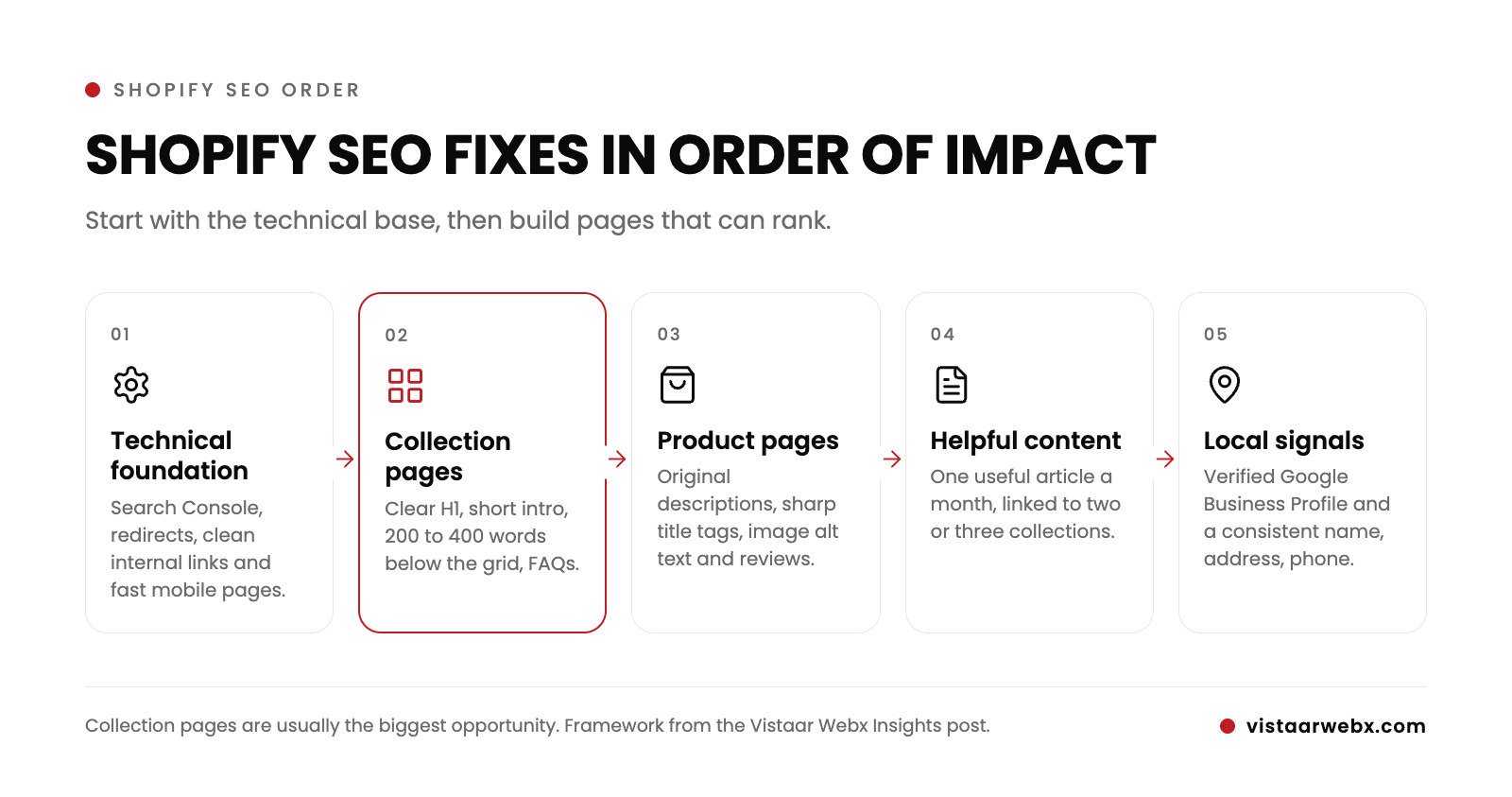
Step 1: Fix the technical foundation
Check indexing in Google Search Console
Start with Google Search Console. Verify your domain, submit the sitemap at yourdomain.com/sitemap.xml, and open the Pages report. Look for:
- Important product and collection pages marked as "Crawled, currently not indexed"
- Pages marked "Duplicate without user-selected canonical"
- 404 errors from old product URLs that were deleted
When you delete or rename a product, add a URL redirect in Shopify admin (Online Store, Navigation, URL Redirects) to the closest live page. Every dead URL that had links or rankings is lost value.
Use the right internal links
Many Shopify themes link to products through collection paths like /collections/sarees/products/banarasi-silk. Shopify sets the canonical to /products/banarasi-silk, which helps, but it is cleaner if your theme links directly to the /products/ URL. Ask your developer to check the product card snippet in your theme.
Speed on a mid-range Android phone
Most Indian shoppers browse on mobile data. Test your homepage, a top collection and a top product page in PageSpeed Insights, and look at the mobile results. Common fixes:
- Remove apps you no longer use. Uninstalling an app does not always remove its code, so check theme files for leftover scripts.
- Compress and resize images. Upload product images at a sensible size rather than raw camera files.
- Avoid autoplay hero videos above the fold on mobile.
- Limit custom fonts to one or two weights.
- Lazy load images below the fold.
Speed is not only a ranking factor. It affects conversion and your Meta ad costs too, which is why we treat it as one job across SEO and CRO.
Step 2: Build collection pages that can rank
For most D2C brands, collection pages are the biggest Shopify SEO opportunity. People search for categories ("cotton kurta sets for women", "cold brew coffee bags") far more often than for a specific product name they have never heard of.
A collection page that ranks usually has:
- A clear H1 that matches the search phrase, for example "Banarasi Silk Sarees" rather than "Collection 3".
- A short intro above the grid: two or three lines that describe the range and help the buyer choose.
- A longer section below the grid: 200 to 400 words on materials, styles, care, occasions and sizing, plus links to related collections.
- A unique title tag and meta description written for the search, not auto-generated.
- A small FAQ answering real questions buyers ask on WhatsApp or in reviews.
Plan your collections around how people search, not around your internal SKU structure. Keyword research tools, Google's autocomplete and the "People also ask" box will show you the phrases that matter in your category.
Step 3: Make product pages useful, not just pretty
Write original product descriptions
Many Indian D2C stores copy manufacturer descriptions or use the same paragraph across variants. Google treats this as thin or duplicate content. Write a unique description for each main product covering:
- What it is and who it is for
- Material, size, weight and dimensions in clear units
- Care instructions
- What makes it different (craft technique, ingredient, origin)
- Delivery, COD and return details in plain language
Title tags and meta descriptions
A simple pattern for product title tags is: Product name, key attribute, brand. For example: "Handwoven Kota Doria Saree in Mint | Brand Name". Keep it under about 60 characters so it does not get cut off.
Image SEO
Rename image files before upload (mint-kota-doria-saree-front.jpg rather than IMG_4521.jpg) and fill in alt text that describes the image. This helps Google Images, which can be a meaningful source of traffic for fashion, jewellery and home decor.
Reviews and structured data
Product reviews add fresh, original text and help shoppers decide. Most Shopify themes and review apps output product structured data (price, availability, rating). Check a product URL in Google's Rich Results Test to confirm it is valid and that there are no duplicate schema blocks from two different apps.
Step 4: Add content that answers buying questions
A blog helps Shopify SEO when it answers questions your buyers ask before they buy, and links naturally to the relevant collection. Good topics for Indian D2C brands:
| Category | Example article topics |
|---|---|
| Handloom and sarees | How to identify a pure Banarasi silk saree, how to care for handloom cotton |
| Skincare | How to build a routine for humid weather, ingredient explainers |
| Jewellery | How to clean silver jewellery at home, gifting guides for festivals |
| Coffee | Brew guides for French press and pour over, roast levels explained |
| Food | Recipes using your product, sourcing stories |
One useful, well-structured article a month that links to two or three collections is worth more than ten thin posts.
Step 5: Local and brand signals
If you have a physical store or studio, create and verify a Google Business Profile, keep the name, address and phone consistent across the web, and link it to your website. Brand searches also matter: as more people search your brand name directly, Google trusts the site more. Ads, PR, creator collaborations and marketplace listings all feed this.
A monthly Shopify SEO routine
- Check Search Console for new indexing errors and 404s.
- Review which queries bring clicks, and which pages rank on page two (positions 11 to 20). These are your quickest wins.
- Improve one collection page with better copy, FAQs and internal links.
- Publish one helpful article linked to a collection.
- Test mobile speed after any new app or theme change.
- Add redirects for any deleted or renamed products.
Mistakes we see on Indian Shopify stores
- Leaving default "Home page" or store name as the homepage title tag
- Out-of-stock products deleted instead of kept live with a "notify me" option or redirected
- Collection pages with zero text
- Five review and SEO apps fighting each other, each adding scripts
- Changing URL handles without redirects after a redesign
If you are planning a redesign, build SEO into the structure from the start rather than fixing it later. You can see the kind of Shopify storefront work we do in our Siolim (UX audit and redesign) and Nanyaa (storefront build) case studies.
Frequently asked questions
Is Shopify good for SEO compared to WordPress? Shopify covers the technical basics well for most D2C stores. WordPress offers more control over URLs and content, but needs more maintenance. For a product-led brand, a well-structured Shopify store with good collection and product content can rank well.
How long does Shopify SEO take to show results? Technical fixes can show impact within weeks once Google recrawls the pages. Content and collection improvements usually take a few months to build rankings, especially in competitive categories.
Do I need an SEO app on Shopify? Not always. Many basics can be handled in Shopify admin and the theme. Use apps only where they solve a clear problem, and check that they do not slow down your store.
Should I remove out-of-stock products? If the product will come back, keep the page live and mark it out of stock. If it is gone for good, redirect the URL to the closest product or collection.
Get a Shopify SEO and CRO review
If your store gets ad traffic but almost no organic visits, the fixes above are a good place to start. We work on Shopify builds, UX and SEO as part of our services. Tell us about your store and we will tell you where the biggest gaps are.
- Shopify SEO
- ecommerce SEO
- D2C India
- collection pages
- Google Search Console